Thunderstorm & lightning tracker | News
Thunderstorm & lightning tracker in live. News about Meteorage and detection of lightning.
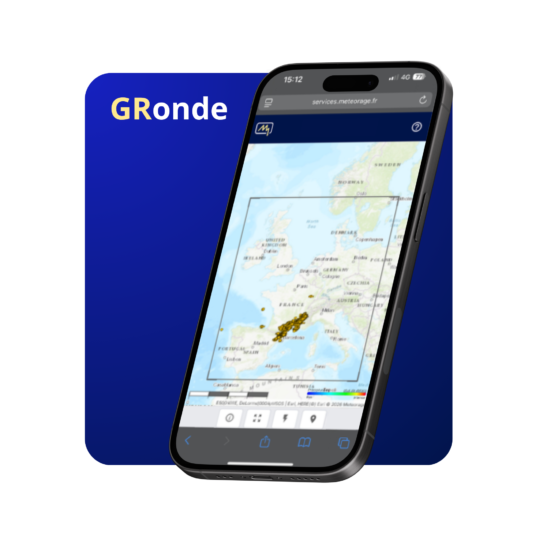
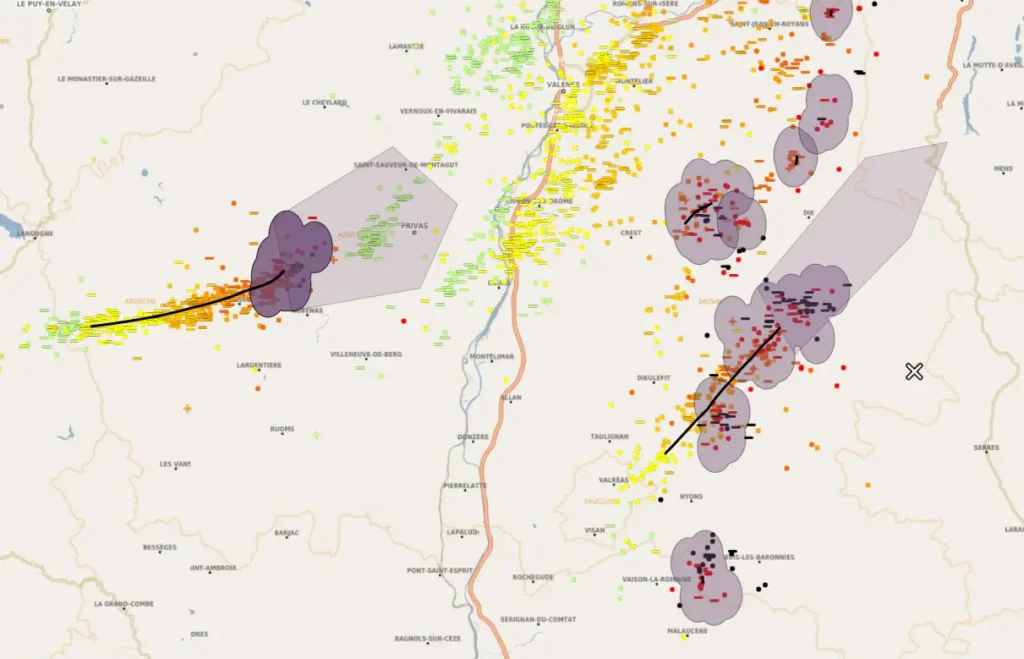
Map of lightning and thunderstorms
Updates: every 5 minutes.
Time range: 15 minutes (max. 2,000 strikes).
The latest lightning flashes, and in recent years
How do you manage the risks posed by thunderstorms for your business?
Case studies
Lightning detection
Our european network of over 130 interconnected sensors detects lightning in real time. Our teams examine each event to provide a clear and factual understanding of thunderstorm activity.
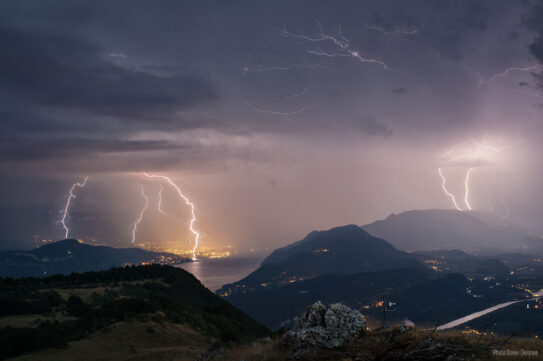
May 15 2026, 00:00–15:00 Nocturnal thunderstorms over Italy
Convection mainly driven by a marked upper-level forcing
⚡ 6,658 flashes detected
⚡ 2,489 cloud-to-ground flashes
A large low-pressure system centered over the North Sea has been driving atmospheric dynamics across most of Europe in recent days.
It extends a particularly deep and elongated talweg, whose axis reaches
down to the North African coasts, creating a highly unstable and convection-favorable environment across Western and Southern Europe. During the first days, thunderstorm activity was concentrated over Western Europe, particularly France and the Iberian Peninsula.
On May 15, the talweg gradually shifts eastward, and convection followed suit, moving towards the Italian Peninsula and the Balkans. It was during the night of May 15 to 16 that the episode peaked over Italy: Meteorage network recorded a high number of lightning flashes. Although intra-cloud flashes remained dominant in absolute terms,
as is almost always the case in thunderstorms, the proportion of
cloud-to-ground flashes was particularly high for this type of event. Moreover, the fact that most of the activity occurred during the night is a signature of this type of episode driven by upper-level dynamics (these dynamics influence the timing and intensity of thunderstorms, but not the distribution between IC and CG flashes).
Under typical conditions, thunderstorms develop in the afternoon: it is the warming of the ground by the sun that destabilizes the lower levels of the atmosphere and fuels instability. At night, without solar radiation, this “thermal” instability naturally decreases, and thunderstorm activity most often dissipates. Except when another driver takes over: upper-level forcing. In concrete terms, this is a fast atmospheric flow located around 9–10 km altitude, capable of “lifting” air upward and forcing convection to trigger, independently of ground heating. Over Italy that night, the forcing was strong enough to maintain, and even intensify, thunderstorm activity, whereas the thermal context alone would probably not have been sufficient.
Unlike ordinary thunderstorms, supercells feature a rotating updraft. This rotation allows them to persist for several hours, whereas a typical thunderstorm dissipates in less than an hour. Hailstones are therefore suspended aloft for long periods, accumulating successive layers of ice. When they eventually fall, they can reach the size of a walnut or even a golf ball. This is why supercells are responsible for nearly all large hail events.
Read our news
& discover
our resources
Customised decision support tools
Applying our extensive knowledge of thunderstorms and lightning, we can design solutions just for you, with the best possible performance, to prevent risks affecting people, your business and your infrastructures.
Evaluate your exposure to thunderstorms
Analyze your risks and adapt your means of prevention and protection.
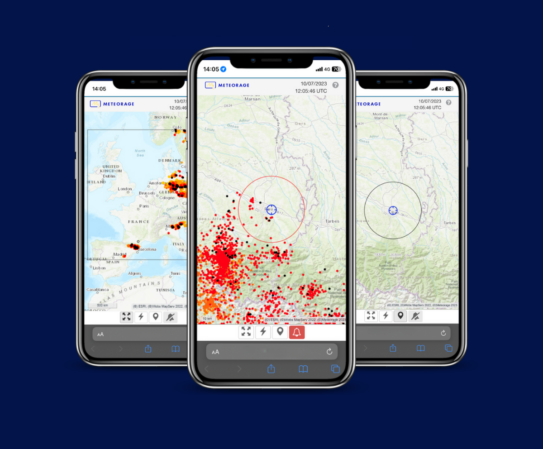
Be alerted to the arrival and end of a thunderstorm
Safeguard people and infrastructures, organize your operations.
Monitor live thunderstorms and lightning
Optimize your preventive measures and mitigate risks as early as possible.
Check any damage and your installations after a thunderstorm
Determine whether lightning has caused damage and save time.
Integrate lightning information
Feed your own tools with our high-resolution flows and data, in real time or past time.
Receive training on lightning and thunderstorm risks
Develop your skills and your employees’ skills.
Develop your own lightning service capability
Take advantage of CATS software and provide your users with services tailored to their requirements.
Journalists and bloggers: raise awareness to enhance knowledge
We play an active role in raising public and media awareness about the hazards and consequences of lightning and thunderstorms.
If you would like to write an article, prevention report or any other type of content on thunderstorms and the risks associated with these dangerous weather phenomena, please contact us via the Press Room and discover our latest press releases: